How long did it take Saquon Barkley to recover from his ACL?
Saquon tore his ACL in September 2020 and returned to NFL play for the 2021 season, roughly a year later. That fits the 9-12 month window that return-to-sport research treats as standard. But the raw timeline hides the real story: at month seven his recovery had stalled, and the turnaround came from changing the method, not from waiting longer.
ESPN reported the season-ending tear in September 2020, in Week 2 of Saquon's third season with the New York Giants. 1 A tear like that puts an athlete on the standard clock: reconstruction surgery, then months of graft healing that no training method can rush, then the long neuromuscular climb back to sport. Research on return to sport after ACL reconstruction consistently lands on 9-12 months as the norm, and a large body of it shows that many athletes never return to their prior competitive level at all. 2
Saquon's calendar looked normal from the outside. What was happening inside the leg by month seven was not. For what each phase should look like, the ACL recovery timeline breaks it down week by week. This article is about what happened when Saquon's timeline stopped cooperating.
Did Saquon Barkley have surgery on his ACL?
Yes. Saquon had ACL reconstruction surgery after the September 2020 tear, followed by standard rehab with his surgical and training teams. Early in the process he also added electrical stimulation work with his training team. The early gains were real. Then they flattened.
By seven months post-op, Saquon could not hold a lunge for more than 15 seconds without form breakdown. Read that again. One of the most explosive athletes in professional football, seven months into a well-resourced recovery, unable to hold a basic lunge. The graft was healing on schedule. The problem was not the knee. The problem was the signal getting to the muscles around it.
I see this pattern constantly. The work is being done, the effort is real, and the output stops responding. The athlete blames himself. Nobody asks whether the method is targeting the right system.
After ACL surgery, the nervous system shuts down access to the muscles around the knee. This is arthrogenic muscle inhibition (AMI): the muscle is structurally present but neurologically muted. Standard rehab often trains around the inhibition instead of resolving it. The athlete gets stronger everywhere except the one place that matters, and progress flattens right when the calendar says it should be accelerating.
What device did Saquon Barkley use for his knee?
Saquon trains with the Volta X, an FDA-cleared direct-current electrical stimulation device that Accelerate ACL uses to restore the connection between brain and muscle. It entered the picture at month seven, when his camp brought in Evan Lewis, founder of Accelerate ACL, to figure out why the recovery had stalled.
Electrical stimulation itself was not new to Saquon's rehab. What changed in that first session was the method: instead of applying stimulation generally, Evan ran a scan-guided assessment to locate exactly where Saquon's nervous system was protecting instead of performing, then applied direct current precisely there, combined with active movement.
The test was a 20-inch box jump. Saquon could not land it. Twenty minutes of scan-guided neuromuscular work later, he could.
"We did 20 minutes of work, and he goes from not being able to jump up onto a 20-inch box to being able to do it. That was the eureka moment. Everyone said, 'Okay, this is it, now let's just go.' It completely changed the course and direction of where his recovery went."Evan Lewis, Founder & CEO, Accelerate ACL 3
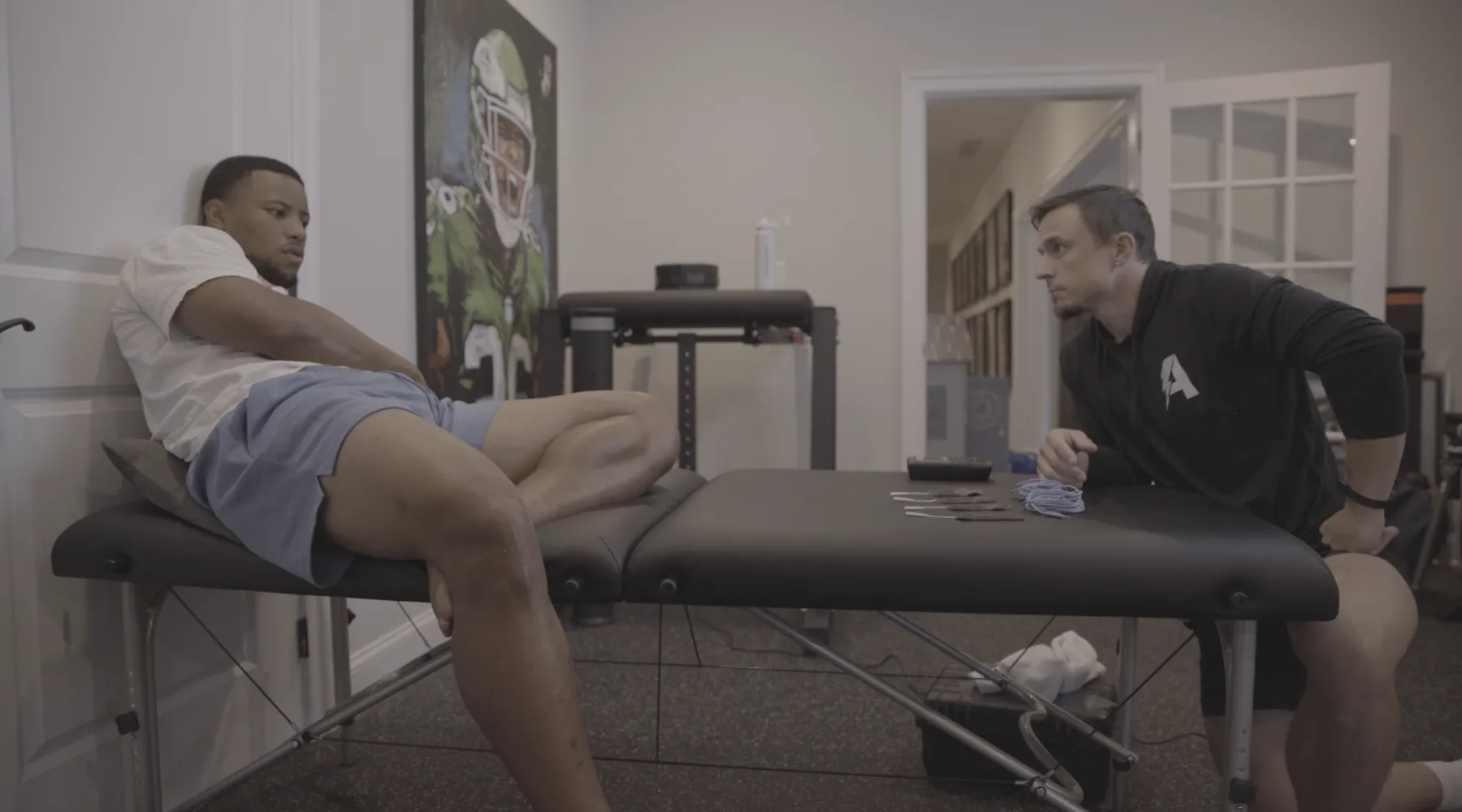
Nothing structural changed in those 20 minutes. No graft got stronger. What changed was access: the nervous system stopped guarding a muscle group it had been protecting for seven months, and the strength that was already there became usable. The knee is the symptom. The disconnect is the problem.
How did Saquon Barkley get so good after his injury?
Two things separate Saquon's story from a standard return-to-play: he kept the neuromuscular work going long after he was cleared, and he treated the injury as identity work, not just knee work. The 2,005-yard season came four years after the tear. It was built in the years between, not handed back at clearance.
After his 2021 return, Saquon continued training with Evan and the Volta X as part of his ongoing preparation and performance work. Most athletes stop when the surgeon says "cleared." Cleared means the graft passed a test. It does not mean the nervous system fires at pre-injury level under game speed and contact. The athletes who come back better than before are the ones who keep closing that gap after everyone else stops measuring it.
The payoff peaked in the 2024 season with the Philadelphia Eagles: 2,005 rushing yards, making him the 9th player in NFL history to pass 2,000, NFL Offensive Player of the Year, First Team All-Pro, a 255-yard single-game franchise record, and a Super Bowl ring.
Then there is the part no scan can measure. In "Faith Delivered | Built. Not Broken.", the short film Saquon made with Accelerate ACL about his recovery, he describes the mental side in his own words:
"I chose to step each day into that fire and do the work that no one will ever see. I chose to attack. To attack each day of this recovery without fear. Not just physically, but mentally, emotionally and spiritually."Saquon Barkley, "Faith Delivered | Built. Not Broken." 4
"This injury was never going to define me. But it did remind me. I'm not here just to run. I'm not here just to play football. I'm here to lead. To build. To inspire."Saquon Barkley, "Faith Delivered | Built. Not Broken." 4
That mindset is not decoration. An ACL tear takes away who an athlete is, not just what a knee can do. The recoveries that end in something bigger than a return almost always pair precise physical work with that kind of deliberate, daily mental attack.
The full arc is now on film. SAQUON, the feature-length Amazon Prime Video documentary that premiered in October 2025, began as a video diary of his ACL recovery and follows him through the contract standoff with the Giants, the move to Philadelphia, the 2,000-yard season, and the Super Bowl win. Evan Lewis appears in the film working with Saquon during their ongoing training together. 5
Frequently Asked Questions
Yes. Saquon Barkley returned to NFL play for the 2021 season and, in 2024 with the Philadelphia Eagles, rushed for 2,005 yards, won NFL Offensive Player of the Year, and won the Super Bowl. He is the 9th player in NFL history to pass 2,000 rushing yards in a season.
Saquon worked with his surgical and training teams through the early phases. Seven months after surgery, with progress stalled, his camp brought in Evan Lewis, founder of Accelerate ACL, whose scan-guided neuromuscular approach changed the direction of the recovery. Saquon continued training with Evan and the Volta X device beyond his return to play.
Yes. SAQUON, the feature-length Amazon Prime Video documentary that premiered in October 2025, began as a video diary of his ACL recovery and follows him through the 2,000-yard season and the Super Bowl win. Evan Lewis appears in the film working with Saquon.
Saquon tore his ACL in September 2020 and returned to NFL play for the 2021 season, roughly a year later. That fits the 9-12 month window return-to-sport research treats as standard, but the raw timeline hides a plateau at month seven that required a change in method, not more time.
Yes. The mechanism his stall exposed, a nervous system protecting instead of performing, is the same in a high school athlete as in an NFL running back. Accelerate ACL works remotely with athletes across the United States using the same scan-guided neuromuscular training and the Volta X device.
Stalled Where Saquon Stalled?
The plateau at month 6-8 is not a willpower problem. It is a nervous system problem, and it responds to the right method. The same team that worked with Saquon works 1-on-1 with athletes across the country, with the Volta X shipped to your home.
Apply for In-Home TrialHave questions first? Book a free 15-minute consult.
Sources
- ESPN. Giants' Saquon Barkley has torn ACL, out for season. September 2020. espn.com/nfl/story/_/id/30443351/
- Ardern CL, Webster KE, Taylor NF, Feller JA. Return to sport following anterior cruciate ligament reconstruction surgery: a systematic review and meta-analysis. British Journal of Sports Medicine. 2011;45(7):596-606.
- Lewis E. First-person account of Saquon Barkley's first Accelerate ACL session. Full timeline: accelerateacl.com/client-stories/saquon-barkley-acl-recovery/
- "Faith Delivered | Built. Not Broken." Short film, Saquon Barkley with Accelerate ACL, 2025. youtube.com/watch?v=1Yr3RBISCUE
- SAQUON. Feature documentary, Amazon Prime Video, premiered October 2025. primevideo.com
Read Saquon's full client story for the complete timeline, key facts, and the science of why the recovery worked.
How fast can you recover from an ACL tear? covers what actually determines your timeline, with documented outcomes from Grady Jarrett and other Accelerate ACL athletes.
The ACL recovery timeline walks through what to expect week by week, and where the common stall points hide.