Most ACL recovery takes nine to twelve months, but the timeline is criteria-based, not calendar-based. Each phase unlocks the next only when your knee meets specific targets: full extension, a quad that fires, no swelling, then strength and symmetry. Two athletes with the same surgery date can be months apart at month six. Hit the criteria in order, and the timeline takes care of itself.
How long does ACL recovery take?
Most athletes return to sport between nine and twelve months after ACL reconstruction, with simpler cases sometimes nearing eight. The date is a guide, not a finish line. What actually matters is whether your knee has met the criteria for each phase. Returning before nine months is consistently linked to higher re-tear rates.
The "nine to twelve months" answer is technically true and practically useless. It treats your knee like a cake in an oven, as if enough time passing is the same thing as being done. It is not. The honest version is this: ACL recovery is a sequence of gates, and time only moves you forward if you actually clear each gate along the way.
Here is the proof that the calendar is the wrong unit. The Delaware-Oslo cohort study followed athletes returning to pivoting sports and found that re-injury risk dropped sharply for every month they waited, up to the nine-month mark.
The same body of research is sobering on second injuries, especially for younger athletes. Coming back is not the finish line; coming back and staying back is.
"Two athletes can have the same surgery on the same day and be in completely different places at month six. The calendar did not decide that. The criteria did."
So instead of asking "how long," ask "what does my knee need to demonstrate to earn the next phase." The table below is the whole map. The rest of this guide walks each row.
| Phase | Rough timeframe | What unlocks the next phase |
|---|---|---|
| Prehab | Before surgery | Full extension, swelling down, quad within ~10% of the healthy leg |
| Phase 1: protect | Weeks 1–3 | Graft protected, swelling controlled, full passive extension, quad firing |
| Phase 2: rebuild | Weeks 4–6 | Normal heel-to-toe gait, off crutches, flexion progressing toward 120° |
| Phase 3: strength | Weeks 7–12 | Quad strength tracking toward 70% of the healthy leg, clean single-leg control |
| Jogging | Months 3–4 | No resting swelling, 70%+ quad strength, controlled single-leg hop |
| Agility | Months 4–6 | Quality deceleration and change of direction before reactive speed |
| Return to sport | Months 9–12 | 90%+ symmetry, passed hop battery, no swelling, passing ACL-RSI score |
What should you do before ACL surgery?
Use the weeks before surgery as prehab. Go into surgery with full extension, minimal swelling, and a quad within ten percent of your healthy leg, and you start the post-op phases weeks ahead. Pre-op quad strength is one of the strongest predictors of how your knee functions two years later.
The window between your tear and your surgery date is not a waiting room. It is the single most wasted, highest-leverage stretch in the whole process. Your nervous system, your range of motion, and your quad all walk into surgery with you, and they walk back out on the other side. The stronger they are going in, the faster you reclaim them coming out.
Three jobs matter before surgery. First, restore full knee extension. Loss of extension is one of the most common post-op complications, and it is far easier to keep than to win back. Second, drive the swelling down, because swelling is what suppresses the quad. Third, keep the quad neurologically connected with simple work like quad sets and straight leg raises, so the line is still open when the shutdown hits. We lay out the full pre-op checklist in our 8 ACL prehab goals and the deeper Ultimate Prehab Guide.
What happens in the first 3 weeks after ACL surgery?
Phase one is protect, reduce, reactivate. Protect the graft, control swelling, restore full extension, and wake the quad back up. The exercises feel almost too basic on purpose: quad sets, heel props for extension, ankle pumps, and straight leg raises once the quad can hold. Full passive extension is the non-negotiable target.
Rehab starts the day of surgery, not weeks later. In these first weeks the graft is at its most vulnerable as it begins the slow biological process of becoming a ligament, so the work is purposeful, not aggressive. Every drill in this phase ladders up to a short list: protect the graft, get the swelling out, lock in full extension, restore kneecap mobility, and reawaken the quad.
Two of those deserve emphasis. Full passive extension, meaning the knee going completely straight, is the priority that everything else depends on. And the quad work matters more than it looks, because a contraction you can barely feel today is the connection you will lean on for the next six months. If you want the technique that makes those early reps actually count, read our breakdown of how to get the most out of your quad sets.
Why won't my quad fire after ACL surgery?
Because the shutdown is neurological, not a matter of effort. It is called arthrogenic muscle inhibition: swelling and pain inside the joint send signals that switch the quad off, even when you try hard to contract it. As little as ten to twenty milliliters of fluid in the knee measurably reduces quad activation. This is normal, and it is the single biggest bottleneck in early recovery.
You will lie there, tell your quad to fire, and feel almost nothing. That is not weakness and it is not you doing it wrong. It is your nervous system actively holding the muscle offline because the joint is irritated. The clinical name is arthrogenic muscle inhibition, and the research is clear that it is a neural problem, not a muscle problem.
This is why two things you would not connect, swelling and weakness, are actually the same problem. Drive the swelling down and you take your foot off the brake. Leave it up and no amount of effort reaches the muscle. That is also why this one mechanism quietly decides your whole timeline: the quad is the engine for extension, for gait, for stairs, for running. If it stays inhibited, every later phase inherits the deficit.
"You can do a thousand quad sets, but if the joint is still telling the muscle to stay off, you are pushing on a locked door. The real work is getting the door unlocked."
Most timelines describe this problem accurately and then move on. The reactivation itself, the part that actually unlocks the door, is where we spend our energy. More on exactly how, lower down.
When can you stop using crutches after ACL surgery?
When you can walk without a limp, not when the calendar says so. Most athletes come off crutches between weeks four and six, but the real test is a normal heel-to-toe gait with full weight on the surgical leg. Ditch them early and limp, and you train a bad movement pattern into your nervous system at the worst possible time.
Crutch weaning is a quality test, not a date. The benchmark is simple and unforgiving: if you cannot walk with a normal heel-to-toe pattern carrying full weight on the surgical leg, you are not ready to walk without help. An altered limp is not a neutral habit you shed later. It is a movement pattern you are actively rehearsing, and your nervous system learns it fast.
By weeks four to six the acute phase is fading: swelling is down, range of motion is climbing toward 120 degrees of flexion, and you start to move like yourself again. Work with your physical therapist to judge your gait quality, not just your pain level. Pain tolerance and functional readiness are two different things, and confusing them is how good recoveries pick up bad habits.
When can you start running after ACL surgery?
Usually months three to four, but only after you meet the criteria, not because twelve weeks passed. You need full pain-free range of motion with no swelling at rest, quad strength at least seventy percent of your healthy leg, and clean single-leg control. The median return to running is about twelve weeks, and running before you are ready spikes graft stress while the tissue is still maturing.
Running feels like the milestone that means you are back. It is also one of the most commonly rushed transitions in the entire process. Running drives forces through the knee that walking never does, and the graft is still biologically immature at three months. So jogging is earned, not unlocked by a date. A scoping review of return-to-running criteria put the typical timeline around twelve weeks, with the emphasis squarely on meeting criteria first.
Before your first jog, you should be able to check these boxes:
- Full, pain-free range of motion with no swelling at rest
- Quad strength at least 70% of your healthy leg
- Controlled single-leg squats and a single-leg hop with no compensation
- A normal walking gait with no limp over longer distances
When you do start, start with walk-jog intervals on a flat, predictable surface and let the knee's 24-hour response be your guide. No new swelling or pain the next day means you can progress. A flare-up means you pull back and give the tissue more time. Speed, distance, and cutting all come later.
When can you return to sport after ACL surgery?
When you pass the tests, not when the calendar hits a number. Your surgical leg needs 90% or better of your healthy leg on strength and hop testing, no swelling, and a knee you trust again. For most athletes that lands after nine months, because that is when the numbers are real. Rush it, and the odds of a re-tear climb fast.
Between months four and six, recovery starts to look athletic again. Lateral movement, change of direction, and sport-specific patterns get layered in under control, with movement quality leading and speed following. This is the phase where overconfidence is most expensive, because the drills feel easy long before the knee is truly ready for reactive, full-speed chaos. Take the mechanics seriously while they still feel slow.
That focus is not arbitrary. The reason re-tears cluster in cutting and landing is that those are the moments the knee has to absorb and redirect force. Building clean deceleration now is what protects you later. Formal return-to-sport testing, usually beginning around month six, is the gate that decides readiness: limb symmetry of 90% or better on strength and a hop-test battery, full pain-free motion with no swelling, and demonstrated control in sport-specific movement at speed. You meet every benchmark, not most of them. For a sense of what hitting those criteria can look like, read how Grady Jarrett and Saquon Barkley rebuilt to clearance-level numbers.
Why is psychological readiness part of the timeline?
Because fear of re-injury is measurable, and it predicts who actually returns. The ACL-RSI scale scores confidence, emotion, and risk appraisal. Athletes who clear physically but score low psychologically return at lower rates and re-injure more often. This is not weakness. It is a rational response that should fade as strength returns.
Almost every timeline guide ignores this, and it is a real part of the timeline, not a soft add-on. The ACL Return to Sport after Injury scale, or ACL-RSI, is a validated tool that quantifies three things: how you feel about returning, how confident you are the knee will hold up, and how you appraise your own risk of re-tearing. Athletes who are physically cleared but score low on it return to their sport at lower rates and get hurt again more often.
Reinjury anxiety after a tear is a completely rational response to a genuinely threatening event. The problem is when that protective fear does not recede as the knee gets strong and capable. The fix is the same as any other deficit: graduated exposure to harder and harder situations, honest education about what the knee can actually handle now, and, when needed, working with a sports psychologist. Confidence is trained, not waited for.
How AACL reactivates the quad (the part most timelines skip)
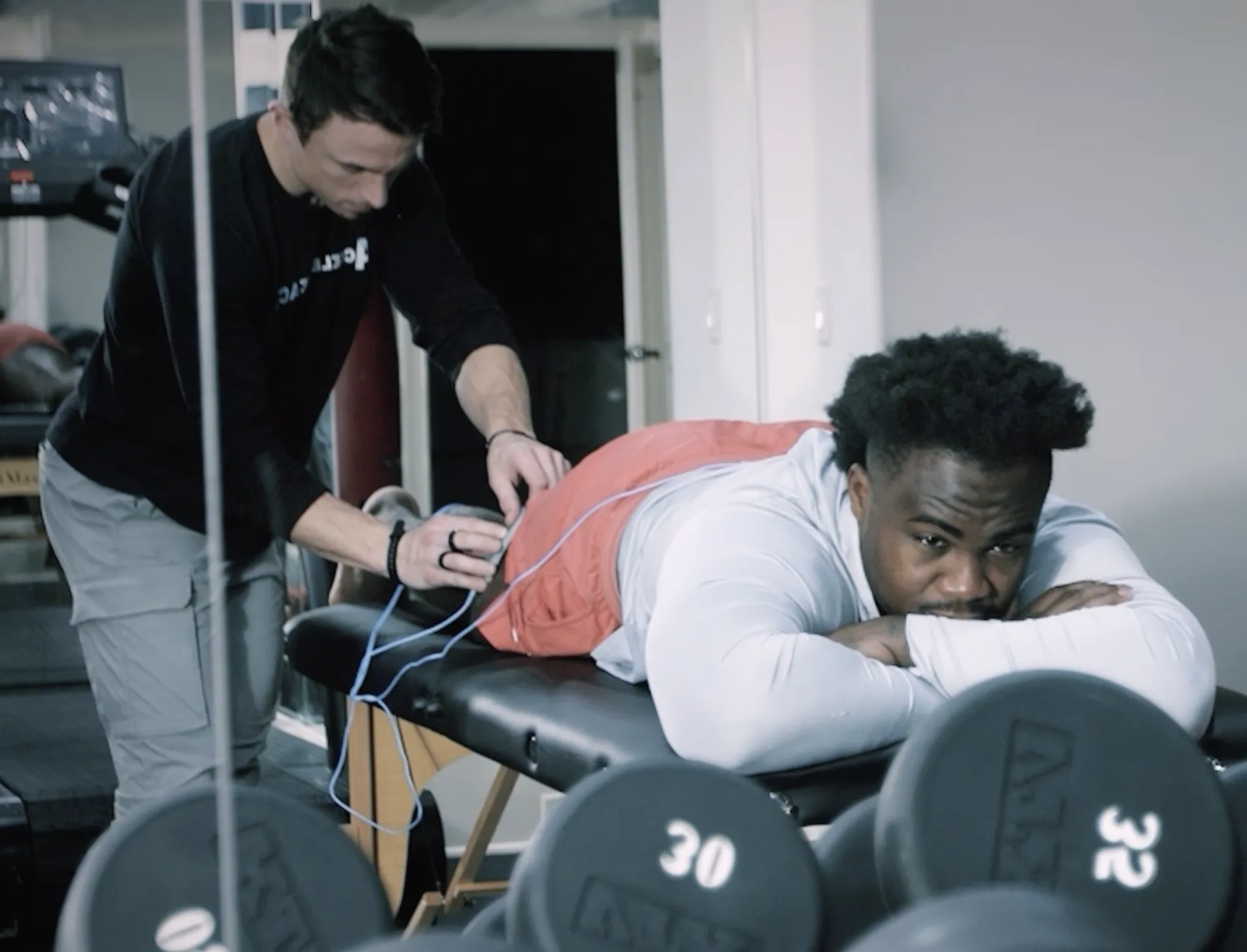
Most timelines describe the quad shutdown in detail and then prescribe quad sets and hope. The reactivation itself is the lever. At Accelerate ACL we attack arthrogenic muscle inhibition directly with the Volta X, an FDA-cleared direct-current device that lets you contract the muscle while it stimulates, paired with a structured program built around each phase above.
Go back to the quad section. The research is unanimous that arthrogenic muscle inhibition is the central bottleneck, and that it cascades into every later phase. Then read what most guides offer as the answer: do your quad sets, and maybe try a stimulation unit if it is stubborn. That is diagnosing the disease in detail and prescribing an aspirin.
What we see across athletes: the ones who reconnect the quad early do not just clear Phase 1 faster, they compress every phase after it, because nothing downstream works until the quad is back online. The athletes who stall at month four almost always stalled at the quad in month one. The bottleneck is rarely strength. It is the connection.
That is the gap the Volta X is built for. It is a portable, FDA-cleared Class II direct-current device used within its cleared indications for muscle re-education and maintaining range of motion. Unlike a typical TENS or EMS unit, which uses alternating current largely for pain or surface activation, the direct-current waveform lets an athlete move and contract during stimulation, which is exactly what reconnecting an inhibited quad requires. The mechanism, paired with targeted exercise, is why we organize the whole Proven Process around getting the muscle back online first.
None of this skips the work or the timeline. The graft still has to mature, the criteria still have to be met, and the months are still the months. What changes is the bottleneck. When the quad comes back online early, every gate after it gets easier to clear on time instead of late.
Know what you are up against
If you are going to make each week count, you need to know the obstacles that derail most ACL recoveries before they derail yours. Our free report breaks down the seven biggest challenges in ACL recovery and how the Accelerate ACL Proven Process is built to overcome them.
See how the program worksOr download the free report first
Heading into surgery soon? Start with the Ultimate Prehab Guide.
References
- Grindem H, Snyder-Mackler L, Moksnes H, Engebretsen L, Risberg MA. (2016). Simple decision rules can reduce reinjury risk by 84% after ACL reconstruction: the Delaware-Oslo ACL cohort study. British Journal of Sports Medicine, 50(13), 804–808. https://bjsm.bmj.com/content/50/13/804
- Wiggins AJ, Grandhi RK, Schneider DK, Stanfield D, Webster KE, Myer GD. (2016). Risk of Secondary Injury in Younger Athletes After ACL Reconstruction: A Systematic Review and Meta-analysis. American Journal of Sports Medicine, 44(7), 1861–1876. https://pubmed.ncbi.nlm.nih.gov/26772611/
- Sonnery-Cottet B, Saithna A, Quelard B, et al. (2019). Arthrogenic muscle inhibition after ACL reconstruction: a scoping review of the efficacy of interventions. British Journal of Sports Medicine, 53(5), 289–298. https://pubmed.ncbi.nlm.nih.gov/30194224/
- Rice DA, McNair PJ. (2010). Quadriceps arthrogenic muscle inhibition: neural mechanisms and treatment perspectives. Seminars in Arthritis and Rheumatism, 40(3), 250–266. https://pubmed.ncbi.nlm.nih.gov/20149405/
- Eitzen I, Holm I, Risberg MA. (2009). Preoperative quadriceps strength is a significant predictor of knee function two years after anterior cruciate ligament reconstruction. British Journal of Sports Medicine, 43(5), 371–376. https://pubmed.ncbi.nlm.nih.gov/19224907/
- Rambaud AJM, Ardern CL, Thoreux P, Regnaux JP, Edouard P. (2018). Criteria for return to running after anterior cruciate ligament reconstruction: a scoping review. British Journal of Sports Medicine, 52(22), 1437–1444. https://pubmed.ncbi.nlm.nih.gov/29626053/
- Wright AR, Richardson AB, Kikuchi CK, Goldberg DB, Marumoto JM, Kan DM. (2019). Effectiveness of Accelerated Recovery Performance for Post-ACL Reconstruction Rehabilitation. Hawai'i Journal of Health & Social Welfare, 78(11 Suppl 2), 41–46. https://pmc.ncbi.nlm.nih.gov/articles/PMC6874690/
Disclaimer: Educational only; not medical advice. Accelerate ACL supplements, but does not replace, physical therapy and medical care prescribed by your healthcare provider. Individual results vary. Consult your physician before beginning any recovery program. The Volta X is an FDA-cleared Class II device used within its cleared indications; Accelerate ACL provides non-clinical training services alongside your physical therapy. Reviewed by Evan Lewis, Founder & CEO, on .