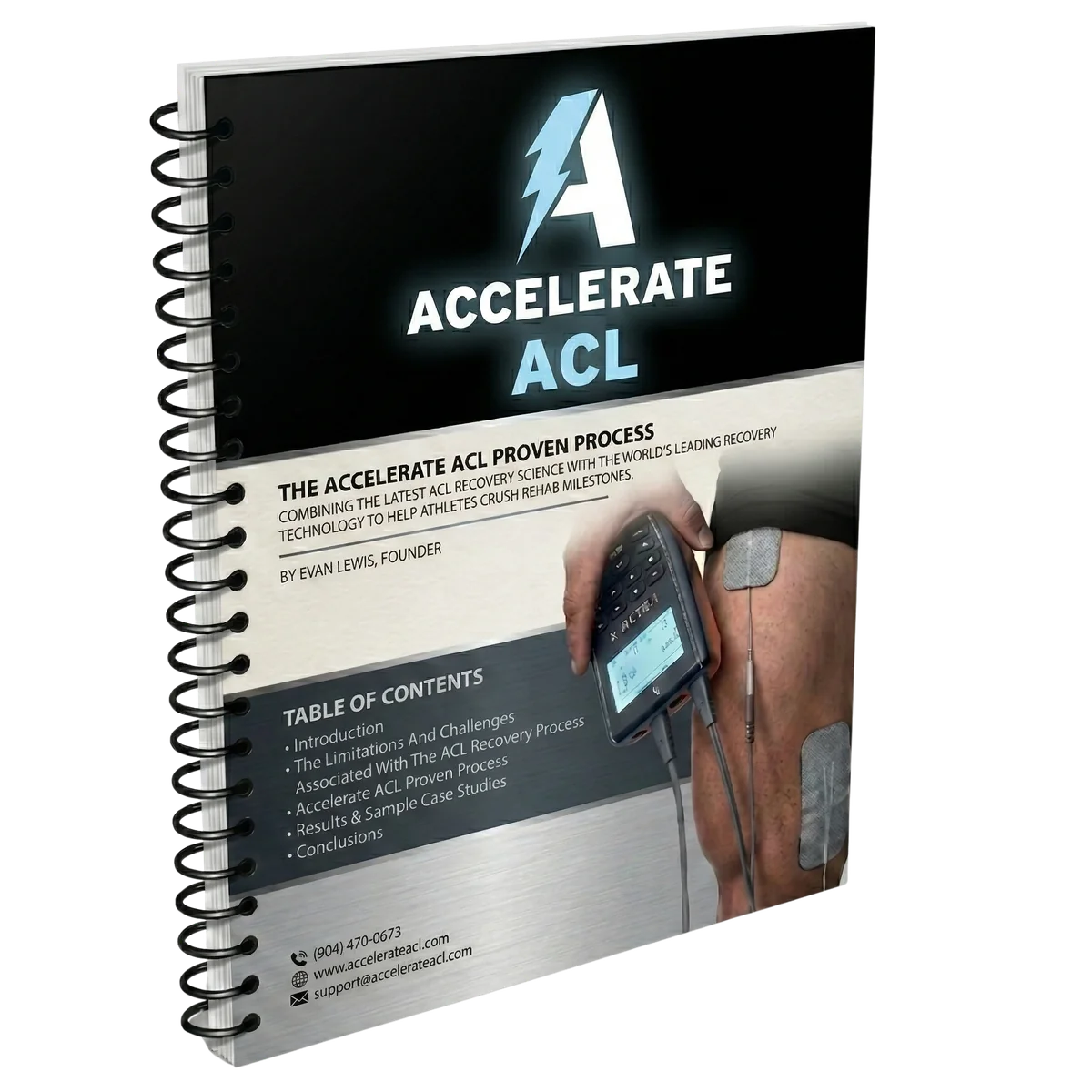
Why this process exists
The Accelerate ACL team combines the latest ACL recovery science with the world's leading recovery technology to help clients crush their rehab milestones. The Accelerate ACL program helps athletes complement their physical therapy, speed up recovery from ACL surgery, accelerate healing day and night, and push themselves through high intensity work for unparalleled results. Overall, the process has been shown to lead to better overall outcomes and yielded results that consistently impress physical therapists and physicians working with clients.
The technology used by the Accelerate ACL team harnesses the power of electricity to upgrade your recovery process. It is unique among electrical stimulation devices for several reasons. Most importantly, Accelerate ACL technology is engineered with a specific waveform that achieves unique recovery and neurophysiological effects. The innovative engineering allows Accelerate ACL clients to reap the benefits of direct current (DC) stimulation, which has been proven to accelerate the body's natural physiological processes of healing and repair, and have unique effects on the neuromuscular system.1–6
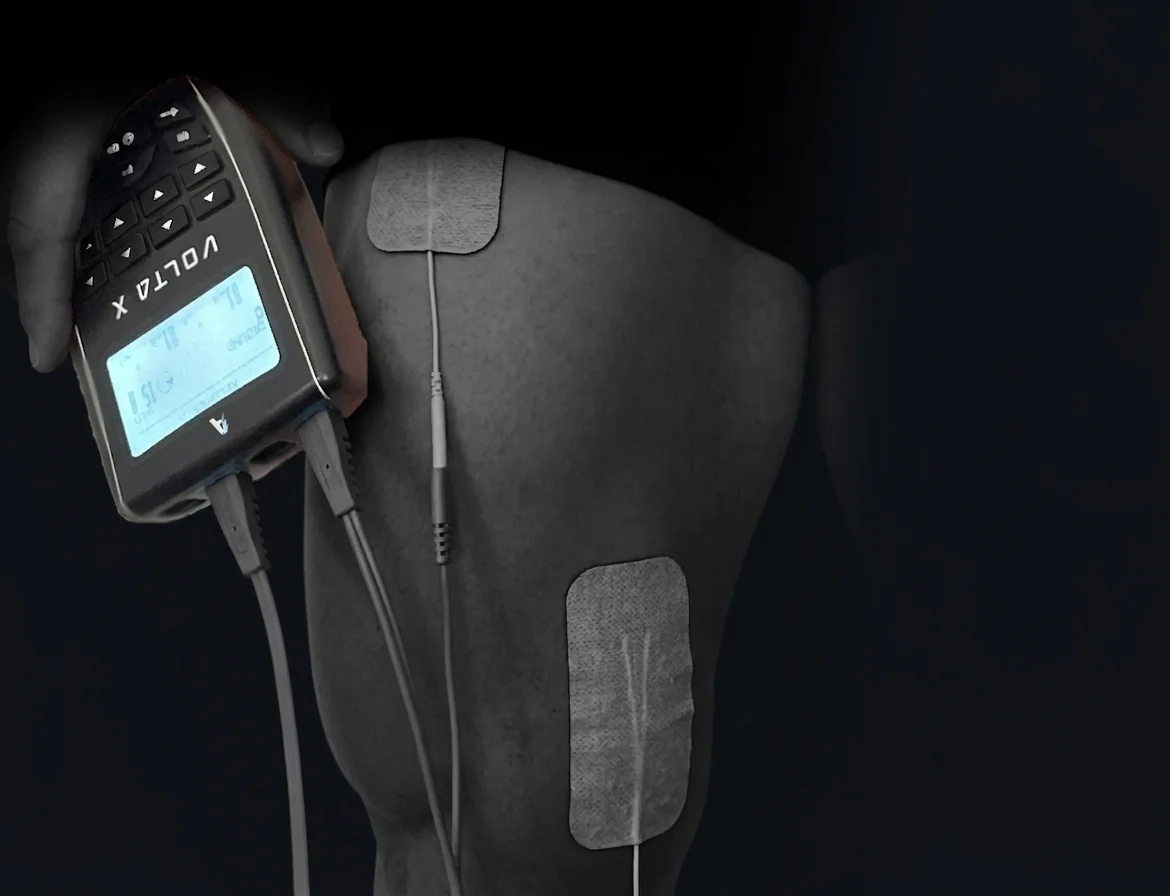
Here, we'll share our hypotheses that describe how the Accelerate ACL Proven Process is used to accelerate recovery from ACL injuries and surgery. We'll describe the major challenges that slow down a typical ACL recovery and go into detail as to how the Accelerate ACL Proven Process can help clients stay on track with the ACL recovery timeline. Then, we'll share a few case studies that show examples of the Accelerate ACL Proven Process in action.
The Accelerate ACL team has demonstrated success with professional athletes all over the country since 2015.
TRUSTED BY ATHLETES FROM 35+ PROFESSIONAL TEAMS


































Section 02 · The Challenges
The limitations & challenges of ACL recovery
Before designing the Accelerate ACL Proven Process and seeking out the most effective recovery technologies, we performed a deep dive analysis of the latest body of research around what currently limits athletes from speeding up the ACL recovery process. Our team identified 7 key limitations associated with the recovery process, which are outlined in the paragraphs to follow.
With this information in hand, we sought out technologies that claimed to be able to overcome such challenges. While we found many technologies that could be utilized to address 1 or 2 of the limitations, only one technology seemed to do it all. Before moving on to how the Accelerate ACL Proven Process leverages this technology, we will outline the primary limitations associated with ACL recovery.
01It is difficult to develop a quality, safe prehabilitation program.
Research suggests that a quality prehabilitation program can be used to set athletes up for success before the ACL reconstruction recovery process even begins. The less pain, more range of motion, and more strength you have in the affected leg before surgery, the more likely you are to have a successful surgical outcome.7 However, major challenges are presented in prehabilitation. Trainers and physical therapists must ask themselves how to effectively load the muscles without putting their client or athlete at risk for further damage. As it should be, safety is considered the number one priority, and oftentimes athletes receive a lackluster prehab program that isn't able to restore range of motion and strength before surgery.
02It takes a long time for the tendon graft to heal.
There is a large body of evidence that shows tendon graft healing is crucial to the success of ACL reconstruction surgery. Successful surgery requires solid healing of the tendon graft in the bone tunnel as soon as possible after surgery, and enhancing this process is crucial for a rapid return to full activity. Blood vessels within and around the joint must mount an adequate healing response in order to set the recovery process up for success. Failure of proper bone-to-graft healing is a common cause of unsatisfactory ACL reconstruction. Oftentimes, this failure is associated with lack of cell signaling and differentiation, resulting in an ineffective healing response between the tendon and the bone.8
03Arthrogenic inhibition of the quadriceps and hamstrings occurs after ACL reconstruction.10,11
In other words, the body "deactivates" the muscles associated with moving the knee joint through a range of motion. The nervous system does this with good intent: its number one concern is safety and it realizes a severe trauma has taken place in the general area. However, if athletes are hoping to return to sport as quickly as possible after surgery, it is imperative that these muscles are reactivated and the arthrogenic inhibition is overcome. Failure to do so can lead to extension deficit, gait abnormality, quadriceps atrophy, poor function, dynamic instability, persistent knee pain, and osteoarthritis.10
04Range of motion often does not come back quickly enough.
During the ACL recovery process, physical therapists and physicians take multiple range of motion measurements. One of their top priorities is to re-establish full range of motion, because it is imperative to a successful outcome. The faster that full range of motion is restored, the faster your recovery process will be. Due to the arthrogenic inhibition referenced above, range of motion can often be slow to come back after surgery, which drastically affects outcomes. If an athlete is behind with range of motion goals just 4 weeks after surgery, they are at risk for a slower recovery and increased chances of osteoarthritis, developing knee pain, quadriceps weakness, decreased ability to generate force, and increased load on the joint.12,13
05Poor biomechanical patterns develop.14,15
Oftentimes, an ACL tear is the result of the body inadequately absorbing force through its primary force absorbers: the muscles. When the muscles fail to absorb force properly, it forces other tissues, like the ACL, to pick up the load, putting it at an increased risk for tear. Inadequate force absorption by the muscles often goes hand in hand with poor biomechanical patterns that existed before the tear. These poor biomechanical patterns are further exacerbated by ACL reconstruction, as the body learns to compensate for the surgically repaired knee. Unfortunately, if not addressed properly, they introduce an increased risk for additional injury after surgery.
06Deficits in quadriceps strength often exist even when athletes return to sport.
As a result of arthrogenic inhibition, quadriceps strength in the affected leg often does not return to the same level as before the injury. Side to side quadriceps deficits are known to be one of the reasons that poor biomechanical patterns highlighted above develop. On average, the affected quadriceps has a deficit of 23% of the strength compared to the non-affected leg 6 months after surgery and a 14% deficit 12 months after surgery.16,17 In order to accelerate the recovery process and set athletes up for success, these deficits need to be corrected.
Average post-ACL quadriceps strength gap at 6 months, even when athletes are cleared to return to sport.
07Return-to-play protocols are not well established.
There is no standardized return to play protocol for ACL reconstruction followed by the majority of clinicians. This can commonly lead to situations where the athlete is cleared to return to sport without ensuring that the proper goals have been met. If the athlete is not properly tested before returning to play, it can also lead to psychological barriers once back on the field, which may increase the risk of a future injury. A proper return to play protocol should use well established metrics focused on ensuring restored knee function, addressing psychological barriers, preventing further knee injury, and optimizing long term quality of life to ensure the athlete can return to the field safely and with confidence. Additionally, it is well established that continued neuromuscular training, even after return to play, reduces the risk of re-injury.15,16
Section 03 · The Proven Process
The Accelerate ACL Proven Process
The Accelerate ACL Proven Process was designed specifically to overcome each of the 7 most common limitations listed above during the recovery process. After reviewing the available literature and testing out many technologies that may aid the ACL recovery process, we landed on one that has proven to help athletes overcome each of the challenges and get ahead of the traditional ACL recovery timeline.
As is described above, the preferred technology at Accelerate ACL utilizes an innovative direct current (DC) electrical stimulation technology, which provides many unique healing and neurophysiological effects. Based on the extensive body of knowledge at Accelerate ACL, a program was designed to harness the benefits of the DC technology in each stage of the recovery process.
One of the most crucial and overlooked aspects of ACL recovery is prehabilitation; however, designing a safe, productive prehab program can be difficult. DC stimulation can help athletes to overcome these challenges. During the Prepare phase of the Proven Process, clients spend 2–6 weeks safely prehabbing utilizing DC technology.
One of the many unique characteristics of DC electrical stimulation is that it allows athletes to combine stimulation with active range of motion movements. Most electrical stimulation devices cause the muscles to lock up, making it impossible to combine with movement. However, the innovative waveform design of AACL technology allows users to simultaneously load the muscle with electricity while moving through a full range of motion. In effect, AACL clients gain more recruitment with less external load and less strain on the joints, which allows them to prehab more safely and without pain.
This is a common feature that the Proven Process taps into throughout the rehabilitation process. Utilizing the AACL program, many clients have felt close to or at 100% going into surgery, putting them in great position for a successful outcome on the back end.
In order to facilitate the graft-tendon healing process, low levels of DC stimulation are applied as close to the surgical site as possible immediately after surgery. Direct current electrical fields can modulate a number of factors involved in the healing response,1 as it brings needed blood flow, nutrients, and specialized cells to the area.
During the AACL Proven Process, clients utilize the technology in this way during the early phases of rehabilitation until they have been cleared by a physician to begin movements associated with physical therapy.

"My son tore his ACL playing lacrosse. Accelerate ACL has been amazing to work with. My son uses FaceTime to have virtual sessions to learn some of the most cutting edge technology in the country. He is 2.5 months post surgery and is well ahead of his recovery schedule thanks to Accelerate ACL."
Curtis · Father of high school lacrosse playerOnce athletes have been cleared for movements associated with physical therapy, the main priority of the AACL Proven Process becomes overcoming arthrogenic inhibition and reactivating the quadriceps and hamstrings.
The DC technology is used in a similar manner to the Prepare phase in that high levels of electrical stimulation are combined with active range of motion movement. In this case, the stimulation is targeted directly at the quadriceps muscle. A 2019 RCT (Wright et al.) found 3:1 greater thigh circumference gains in patients using direct-current stimulation combined with isometric rehab versus isometric rehab alone (p<0.001, n=25)1, supporting what AACL has seen in practice: the body relearns how to recruit the quadriceps at a meaningfully faster rate when DC is added to traditional rehab.
Direct current + isometric rehab vs. isometric rehab alone over 16 sessions (Wright et al. 2019, n=25, p<0.001).
Once the quadriceps and hamstrings have been activated, the AACL program focuses on restoring full range of motion. After ACL surgery, there are two primary measures that must be hit. Athletes should have full flexion (knee bend) of at least 135 degrees and full extension (the knee should be able to fully straighten).
A combination of exercises are utilized during this stage with a full focus on flexion and extension. Athletes combine simultaneous application of the DC current with a squat and straight leg hip hinge pattern to re-train the muscles to work properly through a full range of motion. Typically, AACL athletes regain full range of motion within the first 1–3 weeks after being cleared for movements associated with physical therapy.
With full range of motion restored, an athlete's body starts to feel as if it is back to its baseline level of movement. At this point, movement is comfortable and relatively pain free. Stage 5 focuses on identifying and resetting poor biomechanical patterns that were present before the injury or that have developed since the injury.
Utilizing technology, the AACL team can help athletes identify where muscle dysfunction exists in the body that is driving poor biomechanical patterns. Once the problem has been identified, athletes work for 1–2 weeks to reprogram and reset the proper, more efficient pattern into their normal movement, decreasing the chance of re-injury.

"I learned about Accelerate ACL through a friend who also tore his ACL. AACL targeted all my weak spots in my leg that were disabling me from fully extending… It allowed me to feel comfortable around school sooner and got my knee back to normal for soccer."
Naja · Division 1 soccer playerThe last box that has to be checked before starting the conversation of return to sport is ensuring there are no strength deficits between quadriceps. Athletes work through grueling sessions of isometric work under high load of direct current for a minimum of 2–3 weeks. They are coached to maintain proper position, not allowing the body to favor one side or the other as it fatigues.
The focus on proper position forces the body to rebuild strength in both sides equally, limiting the quadriceps strength deficit on the post-surgical leg. Additionally, isometric training has proven to improve hamstring stiffness,18 which decreases loading on the ACL, decreasing the risk of future re-injury.
Athletes work tremendously hard to get their bodies back in shape after ACL surgery, but are often left on their own to complete the process once cleared by the doctor and physical therapist. Specific tests are recommended by the AACL team, in conjunction with those used by the doctor and PT, to ensure the athlete is ready not only physically, but psychologically to return to play.
In the common case that psychological barriers are present, the AACL team coordinates care with a mental conditioning coach to help athletes become fully confident upon returning to the field. The AACL team also coordinates for continued neuromuscular training even after returning to the field, which has been proven to drastically decrease the risk of re-injury.

"I honestly never thought I was going to wrestle ever again after tearing my MCL 3 times and then an ACL injury. Then I found Accelerate ACL and it changed my life. It was not easy at all. In fact, it was the hardest thing that I have ever done, but it was so worth it. I am stronger and faster than I have ever been."
Wyatt · High school wrestlerSection 04 · Results
Results & sample case studies
The effects of the Accelerate ACL Proven Process have been demonstrated with hundreds of clients in numerous case studies. Many case studies show meaningful reductions in recovery time when recovering from surgery. The process is tailor made for an athlete's mentality, but people of all skill and ability levels have gone through it with great levels of success. Here, we will detail the results of various stages of the Proven Process.
Prepare for surgery with prehab
One of the most important indicators of ACL reconstruction success is the preoperative condition of the athlete. If the athlete has been able to normalize gait patterns, restore range of motion, decrease pain levels, and start strengthening before surgery, they will put themselves in a place for success.
In this case study, an AACL client tore her ACL playing recreational sports. Immediately after suffering the injury, she experienced severe pain, swelling, and an inability to bear weight on the affected leg. Range of motion was limited to −15° extension and 55° flexion. Within 24 hours of utilizing the AACL Stage 1 Prepare program and direct current technology, range of motion had improved to −6° extension and 77° flexion.
Restore range of motion & eliminate poor biomechanical patterns
A 38 year old female lacrosse player requested to start the AACL process after surgery. The operating physician tasked her and the rehab team with the goal of restoring range of motion and normalizing gait within 11 weeks of surgery.
The athlete began the Accelerate ACL Proven Process at Stage 3: Reactivate. After 1 week of AACL work, her physical therapist reported that full range of motion had been restored. After 2 weeks of AACL work, her physical therapist reported that her gait patterns had normalized.
After completing the AACL Proven Process, the athlete stated that her body felt better than it had in 16 years and returned to lacrosse.
Eliminate pain quickly after surgery & get back to running
A high school football player requested Accelerate ACL services after being referred by his head coach. He had experienced a torn ACL at the end of his junior season and was concerned he would miss his senior year. Within 2.5 weeks of starting work with the AACL Proven Process, the athlete was able to move freely throughout the day without pain and feeling confident enough to start running and jumping again.
After 5 weeks, the athlete reported feeling fully healed and that he was ready to start strengthening again. The player returned to the field in plenty of time for the start of his senior season and scored 4 touchdowns in his first game back on the field.

"By the end of the first week, I had full bend back in my knee and was able to run and jump again, and by the end of the 3rd week, it felt fully healed. I would recommend Accelerate ACL to anyone looking to recover as quickly as possible to get back to doing the things that they enjoy."
Cameron · High school football playerImprove functional scores quickly after surgery
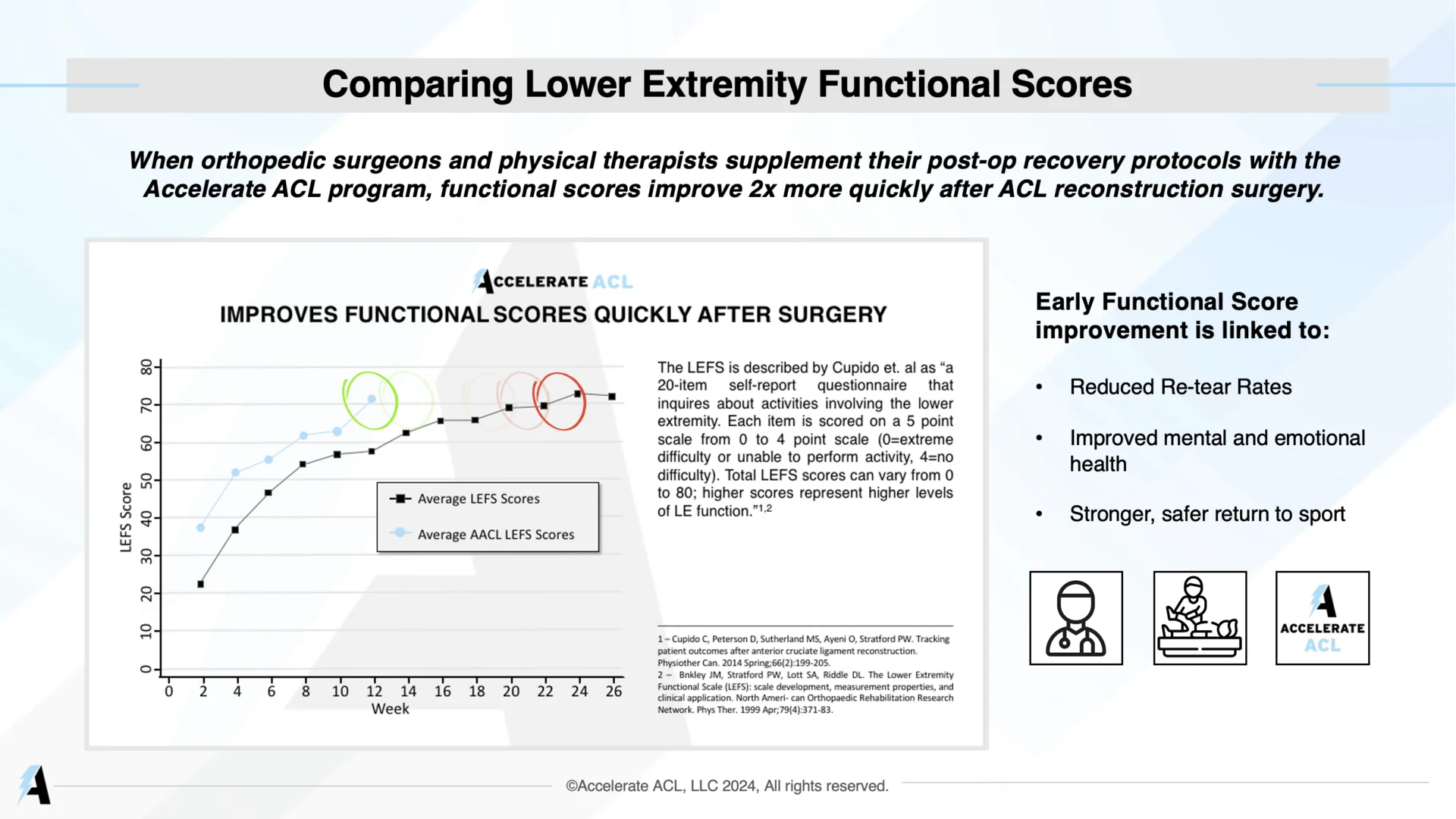
A 39 year old male CrossFit athlete tore his ACL and sprained his MCL in May 2020. After having surgery to reconstruct the ACL, he began work with the Accelerate ACL Proven Process. Lower extremity physical function status was measured by the athlete's physical therapist at 1 week, 4 weeks, 8 weeks, and 12 weeks post-op using the Lower Extremity Functional Scale (LEFS). The LEFS is described by Cupido et. al as "a 20-item self-report questionnaire that inquires about activities involving the lower extremity. Each item is scored on a 5 point scale from 0 to 4 point scale (0=extreme difficulty or unable to perform activity, 4=no difficulty). Total LEFS scores can vary from 0 to 80; higher scores represent higher levels of LE function."20,21
At 12 weeks post-op, the AACL athlete scored 75/80 on the LEFS, compared to a reported average score of 63/80. Another study reported that an average score of 63/80 would not be expected until 16 weeks after surgery.22 In addition to the higher than normal LEFS score at 12 weeks post-op, the athlete reported being able to deadlift 325 lbs. for sets of 6 repetitions.
Section 05 · Conclusions
Conclusions
We believe that the Accelerate ACL Proven Process can dramatically accelerate the recovery process after ACL injuries and surgery.
In this white paper, we shared our hypothesis based on a robust review of the latest ACL reconstruction research and a combined decade of experience working with direct current electrical stimulation technologies. As we complete more scientific studies in the future, we are excited to quantify the results and share with you.
In the meantime, we hope to offer positivity to those of you who have recently suffered an ACL injury. Sometimes, in what feels like the most devastating moments of our lives, it can seem impossible to find a glimmer of light. With the information presented in this paper, we hope that we've empowered you to believe that you can (and will) come back, bigger, stronger, and faster, on the back side of this injury.
"When I tore my ACL, Accelerate ACL was one of my first calls (even before my immediate family knew of my injury). I started at AACL two weeks post surgery and within just a few days, I had almost complete range of motion back. Through AACL, we discovered the old injuries that ultimately caused the tear — I've learned so much and feel better than I have since college! The whole AACL team is wonderful to work with and they truly care about all of their clients."
Bobbie · Lacrosse playerReady to talk to the team?
If you or your athlete is recovering from an ACL injury, we'd love to learn more about the situation and figure out how the Proven Process fits.
References
- Wright AR, Richardson AB, Kikuchi CK, Goldberg DB, Marumoto JM, Kan DM. Effectiveness of Accelerated Recovery Performance for Post-ACL Reconstruction Rehabilitation. Hawaii J Health Soc Welf. 2019;78(11 Suppl 2):41–46.
- Chen Y, Ye L, Guan L, Fan P, Liu R, Liu H, Chen J, Zhu Y, Wei X, Liu Y, Bai H. Physiological electric field works via the VEGF receptor to stimulate neovessel formation of vascular endothelial cells in a 3D environment. Biol Open. 7(9), 2018.
- Hu WW, Chen TC, Tsao CW, Cheng YC. The effects of substrate-mediated electrical stimulation on the promotion of osteogenic differentiation and its optimization. J Biomed Mater Res B Appl Biomater. 2018.
- Rouabhia M, Park H, Meng S, Derbali H, Zhang Z. Electrical stimulation promotes wound healing by enhancing dermal fibroblast activity and promoting myofibroblast transdifferentiation. PLoS One. 8(8), 2013.
- Borgens RB, Vanable JW, Jaffe LF. Bioelectricity and regeneration. I. Initiation of frog limb regeneration by minute currents. J Exp Zool. 200(3), 1977.
- Leppik LP, Froemel D, Slavici A, Ovadia ZN, Hudak L, Henrich D, Marzi I, Barker JH. Effects of electrical stimulation on rat limb regeneration, a new look at an old model. Sci Rep. 5, 2015.
- Failla MJ, Logerstedt DS, Grindem H, Axe MJ, Risberg MA, Engebretsen L, Huston LJ, Spindler KP, Snyder-Mackler L. Does Extended Preoperative Rehabilitation Influence Outcomes 2 Years After ACL Reconstruction? A Comparative Effectiveness Study Between the MOON and Delaware-Oslo ACL Cohorts. Am J Sports Med. 2016 Oct;44(10):2608–2614.
- Hexter AT, Thangarajah T, Blunn G, Haddad FS. Biological augmentation of graft healing in anterior cruciate ligament reconstruction: a systematic review. Bone Joint J. 2018 Mar 1;100-B(3):271–284.
- Lampe KE. Electrotherapy in tissue repair. J Hand Ther. 1998 Apr–Jun;11(2):131–9.
- Sonnery-Cottet B, Saithna A, Quelard B, Daggett M, Borade A, Ouanezar H, Thaunat M, Blakeney WG. Arthrogenic muscle inhibition after ACL reconstruction: a scoping review of the efficacy of interventions. Br J Sports Med. 2019 Mar;53(5):289–298.
- Delaloye JR, Murar J, Sánchez MG, Saithna A, Ouanezar H, Thaunat M, Vieira TD, Sonnery-Cottet B. How to Rapidly Abolish Knee Extension Deficit After Injury or Surgery: A Practice-Changing Video Pearl From the Scientific Anterior Cruciate Ligament Network International (SANTI) Study Group. Arthrosc Tech. 2018 May 7;7(6):e601–e605.
- Noll S, Garrison JC, Bothwell J, Conway JE. Knee Extension Range of Motion at 4 Weeks Is Related to Knee Extension Loss at 12 Weeks After Anterior Cruciate Ligament Reconstruction. Orthop J Sports Med. 2015;3(5):2325967115583632.
- Shelbourne KD, Freeman H, Gray T. Osteoarthritis after anterior cruciate ligament reconstruction: the importance of regaining and maintaining full range of motion. Sports Health. 2012 Jan;4(1):79–85.
- Bencke J, Aagaard P, Zebis MK. Muscle Activation During ACL Injury Risk Movements in Young Female Athletes: A Narrative Review. Front Physiol. 2018 May 15;9:445.
- Faltus J, Criss CR, Grooms DR. Shifting Focus: A Clinician's Guide to Understanding Neuroplasticity for Anterior Cruciate Ligament Rehabilitation. Curr Sports Med Rep. 2020 Feb;19(2):76–83.
- Filbay SR, Grindem H. Evidence-based recommendations for the management of anterior cruciate ligament (ACL) rupture. Best Pract Res Clin Rheumatol. 2019 Feb;33(1):33–47.
- Buckthorpe M, La Rosa G, Villa FD. Restoring Knee Extensor Strength After Anterior Cruciate Ligament Reconstruction. A Clinical Commentary. Int J Sports Phys Ther. 2019 Feb;14(1):159–172.
- Blackburn JT, Norcross MF. The effects of isometric and isotonic training on hamstring stiffness and anterior cruciate ligament loading mechanisms. J Electromyogr Kinesiol. 2014 Feb;24(1):98–103.
- Frobell RB, Roos EM, Roos HP, Ranstam J, Lohmander LS. A randomized trial of treatment for acute anterior cruciate ligament tears. N Engl J Med. 2010 Jul 22;363(4):331–42.
- Cupido C, Peterson D, Sutherland MS, Ayeni O, Stratford PW. Tracking patient outcomes after anterior cruciate ligament reconstruction. Physiother Can. 2014 Spring;66(2):199–205.
- Binkley JM, Stratford PW, Lott SA, Riddle DL. The Lower Extremity Functional Scale (LEFS): scale development, measurement properties, and clinical application. Phys Ther. 1999 Apr;79(4):371–83.
- Alcock GK, Werstine MS, Robbins SM, Stratford PW. Longitudinal changes in the lower extremity functional scale after anterior cruciate ligament reconstructive surgery. Clin J Sport Med. 2012 May;22(3):234–9.